
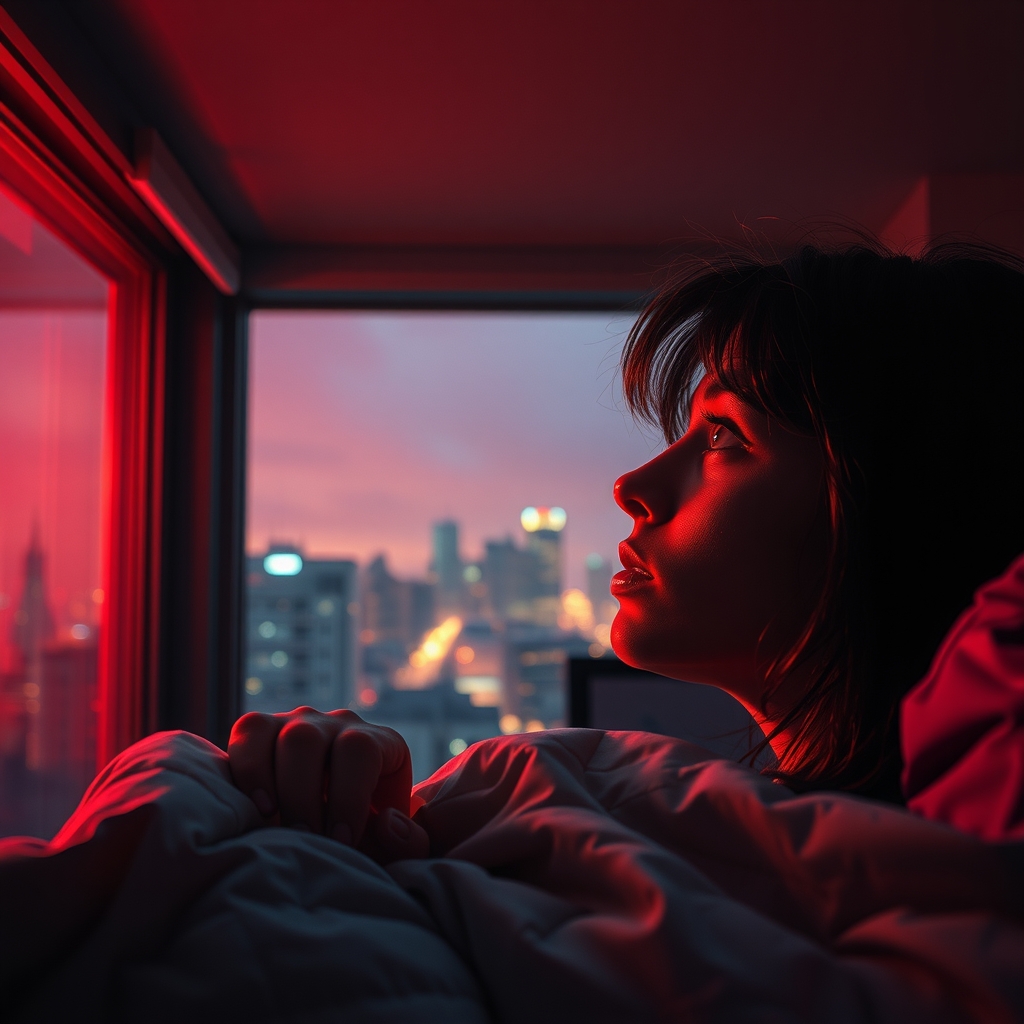
I often lie awake at 2 AM, staring at the cracks on the ceiling, unconsciously rubbing the texture of the quilt with my fingertips. My mind is a chaotic white noise even though I’ve turned off my phone and counted sheep countless times. It’s not just insomnia; it’s the silent scream of my circadian rhythm being gradually snuffed out. Whenever the neon lights outside just fade away, my internal clock is still silently calculating the ‘bill’ of ‘I can sleep two more hours more’, as if time is an elastic band that can be bent at will, and I’m the line stretched nearly to the breaking point. In this darkness, I can feel each of my cells emitting a weak distress signal, but because I habitually delay sleep, I treat these signals as background noise.
\n
We live in a world where ‘efficiency’ is deified and ‘rest’ is demonized. Every alarm clock ringing is a hijacking of physiological instinct, and every moment the lights go out is a leap into the unknown abyss. The first ray of morning sunlight should be the gentlest awakener, yet it’s often obscured by the superstitious sound of alarm clocks, as if the brain requires violent impact to wake up. And at dusk, the golden hour when the body begins to release melatonin and prepare for repair mode is hard forced back by relentless work emails, binge-watching desires, and the cold blue light of phone screens. This day-after-day misalignment makes the endocrine system like a repeatedly deployed commander, though already exhausted, forced to stand on the battlefield until fatigue erupts in another form—either emotional collapse or physical pain.
\n
Remember a friend of mine, she’s the most hardcore ‘overtimer’ in the company, coding until 2 AM every day, and at 6 AM the next morning she’s yawning in the conference room giving a speech. She always feels she lacks willpower, but actually her body has been sending her traffic lights: green during the day, allowing activity; yellow at dusk, warning adjustment; red at night, strictly commanding cessation. She treats these signals as her own weakness, and the more she tries to suppress them, the more intense the body’s counterattack. Until a sudden stomach upset, she realized her insomnia isn’t a personal flaw but an inevitable cost after circadian rhythms are completely erased. That night, after turning off the lights, she didn’t just close her eyes; she also allowed those suppressed biological rhythms to requeue and find long-lost balance.
\n
Circadian rhythm, these four characters hide a biological war that has already begun. The tiny group of neurons in the suprachiasmatic nucleus of the hypothalamus, our body’s master clock, is like a never-retired experienced conductor, relying on light-dark changes to harmonize the activity and rest of every organ. The first ray of morning sunlight, with long wavelengths and warm tones, is the key to recalibrating its frequency; while night darkness is the signal to prompt melatonin secretion and let cells begin repair. However, modern life is an intrusive interference wave. We spend daytime surrounded by artificial light, and extend dusk in screen cold light, as if deliberately putting headphones on the conductor, playing heavy metal completely out of sync with the beat. The result? Cortisol is secreted at wrong times, melatonin peaks are advanced or delayed, and the internal clock of metabolic systems is completely messed up.
\n
This misalignment has consequences far deeper than we imagine. Research shows that long-term circadian disruption isn’t just simple difficulty falling asleep; it’s directly linked to weight gain, decreased insulin sensitivity, and even a high incidence of mood disorders. Office workers who continue high-pressure work at night often feel a heaviness called ‘sleep inertia’ upon waking in the morning, as if their body never truly entered deep sleep repair stages. Their brains are like computers left on, background programs running wild, lacking true sleep cleaning mechanisms. Every turn, every shift, is the body silently crying out against the disrupted rhythm, yet no one can hear that subtle wailing.
\n
I often see such a scene in late-night coffee shops: a young person, holding a half-cup iced Americano, eyes red as bloodshot, the project diagram on the screen glowing, while the outside sky is gradually turning fish-belly white. He sips coffee while keeping his ‘most efficient’ period, not knowing that every sip of caffeine is like throwing a hand grenade at his internal clock. Caffeine has a half-life lasting hours; if consumed after 4 PM, it will still hinder melatonin secretion during deep night stages. This isn’t some advanced biohacking technique; it’s just ignorance and carelessness of physiological rules. When we place ‘efficiency’ above ‘rhythm’, the body will eventually demand that stolen time through insomnia, anxiety, chronic fatigue, in the most direct way.
\n
If the misalignment during the day is progressive erosion, then nighttime rituals are outright destruction. Many people’s dinners aren’t for nutrition but to fill the emptiness caused by haste during the day. Snacks, desserts, greasy meals are like silent firelights, illuminating the digestive system’s supposed resting period. A post-dinner walk should aid sleep, but is often replaced by ‘just half an hour more’ of work, or endless phone scrolling. This ‘eat-play-sleep’ fragmented process makes every organ in the body dance to different beats, ultimately resulting in a complete loss of coordination. When digestive enzymes are still working to break down last night’s residue, and the brain is processing fragmented screen information, falling asleep is naturally an extravagant wish.
\n
Worse still, alcohol has become many people’s ‘booster’ for falling asleep. One drink to sleep, it seems to really let you close your eyes quickly, but the process of alcohol metabolism is actually a sleep quality killer. It suppresses REM sleep, that golden period for memory consolidation and emotional regulation, making the entire night’s sleep seem long in duration but thin in content. Upon waking, you might feel like you’ve been dragged through a long dream, with fuzzy memory and unstable emotions, as if the whole person has been kneaded. This illusion of ‘good sleep’ is actually a severe betrayal of circadian rhythm, making clear-headed white days more difficult, forming a vicious cycle: drowsy days, force sleep with alcohol at night, and be violently awakened by alarms the next morning.
\n
The first step to awakening isn’t to harshly rebuke every past insomnia, but to acknowledge that most of us are unconsciously fighting a life-and-death battle with our biological instincts. Every reason for staying up late, perhaps valid ‘for work’, ‘for learning’, ‘for life’, but accumulated, it’s a tampering with time itself. When we realize that seemingly insignificant habits are gradually eroding the light of our internal clock, a sense of responsibility like never before arises. This isn’t to make oneself ‘perfect’ or to pursue some health data, but to reclaim the right to dialogue with one’s body, letting those ignored signals no longer be treated as background noise.
\n
True change doesn’t need grand rituals; it starts from insignificant details. For example, the first thing upon waking isn’t immediately reaching for the phone to check messages, but walking to the window and letting morning light fall on your skin for at least fifteen minutes. Every light exposure during the day is sending the most explicit ‘morning’ signal to the internal clock. And at dusk, the brightness of artificial light can be gradually dimmed, simulating the color temperature change of sunset, letting the brain begin to predict the upcoming darkness. Dinner can be advanced to 6-7 PM, avoiding the stomach being active during deep sleep; caffeine intake can have a ‘cutoff point’, e.g., no consumption after 3 PM. These seemingly trivial adjustments are, at the physiological level, the most direct re-shaping of circadian rhythm; like puzzle pieces, they gradually piece together an ordered, vibrant daily life.
\n
When these details are no longer merely task checklists but a form of self-respect, the whole person’s state undergoes a subtle shift. Daytime energy is no longer the roller coaster of ups and downs but a steady, sustained flow. Nighttime falling asleep is no longer a long tug-of-war but a natural, gentle descent. My past insomnia, now becomes a journey worth remembering, teaching me to listen to my body. Every circadian rhythm recalibration is like a tiny rebirth, letting me learn how to carve out a quiet, rhythmic corner for myself in a noisy world. This change doesn’t require others’ understanding, nor some popular health doctrine, only you, and your internal clock that has never betrayed you, craving respect.
\n
Sleep, in the opening of this article, I compare it to a hidden tacit understanding, the deepest intersection between day and night. When circadian rhythm is perfectly optimized, sleep is no longer a passive, time-consuming relinquishment but an active, rebirth-filled ritual. Every moment of closing eyes is a return of daytime energy, a repair of body cells, a clearing of brain cache. And every moment of opening eyes is like a traveler who has finally returned home after a long journey. This state makes one no longer view time as a linear, limited resource, but as a circle of mutual nourishment through cyclic repetition.
\n
When your internal clock starts running properly, the first ray of morning sunlight is no longer an enemy but a benevolent guide; the night darkness is no longer a strange fear but a harbor for the soul. You’ll find that the insomnia, anxiety, and fatigue that once troubled you become fragmented, no longer occupying the protagonist position of your life. Instead, there’s a composed peace, a satisfaction of getting a lot done during the day yet still having a high-quality night. Dreams are no longer random fragments; sometimes they become clear and insightful, as if the brain is having a deep, silent conversation during sleep. This change stems from respecting circadian rhythm, and also from rewriting your life’s rhythm.
\n
So, please allow me to end this article once more with a question: In a world where we’re always online and always disturbed, are you willing to return that last bit of your own, gentle, night-time time to your body? May you, upon tomorrow’s morning, no longer be torn apart by the harsh alarm, but gently awakened at that moment; may you, every night, feel that belonging to the circadian cycle, warm and never having left. Because true optimization is never about how to extract time, but about how to let time work for you.
\n
\n
—— END ——
The 2 AM ceiling stare is way too real. Started getting morning light in my eyes within 15 mins of waking up last month — game changer for the evening crash. Still fighting the revenge bedtime procrastination though.
The 2 AM ceiling stare is way too real. What finally broke the cycle for me was forcing 10 mins of cold morning light *before* coffee, even on weekends. The weekend drift kills the rhythm faster than a late-night screen. Hang in there.
The 2 AM ceiling stare is way too real. Started getting morning light in my eyes within 15 mins of waking up last month and it actually shifted my sleep pressure earlier. Still rough on weekends though. Happy 11.11 btw, hope you got some rest instead of doomscrolling deals.
The 2 AM ceiling stare is way too real. Tried the blue light glasses thing for a week, honestly didn’t feel much difference. What actually moved the needle for me was just forcing a hard cutoff — no phone in bedroom after 10. Brutal first few days, but the sleep pressure builds up fast.