
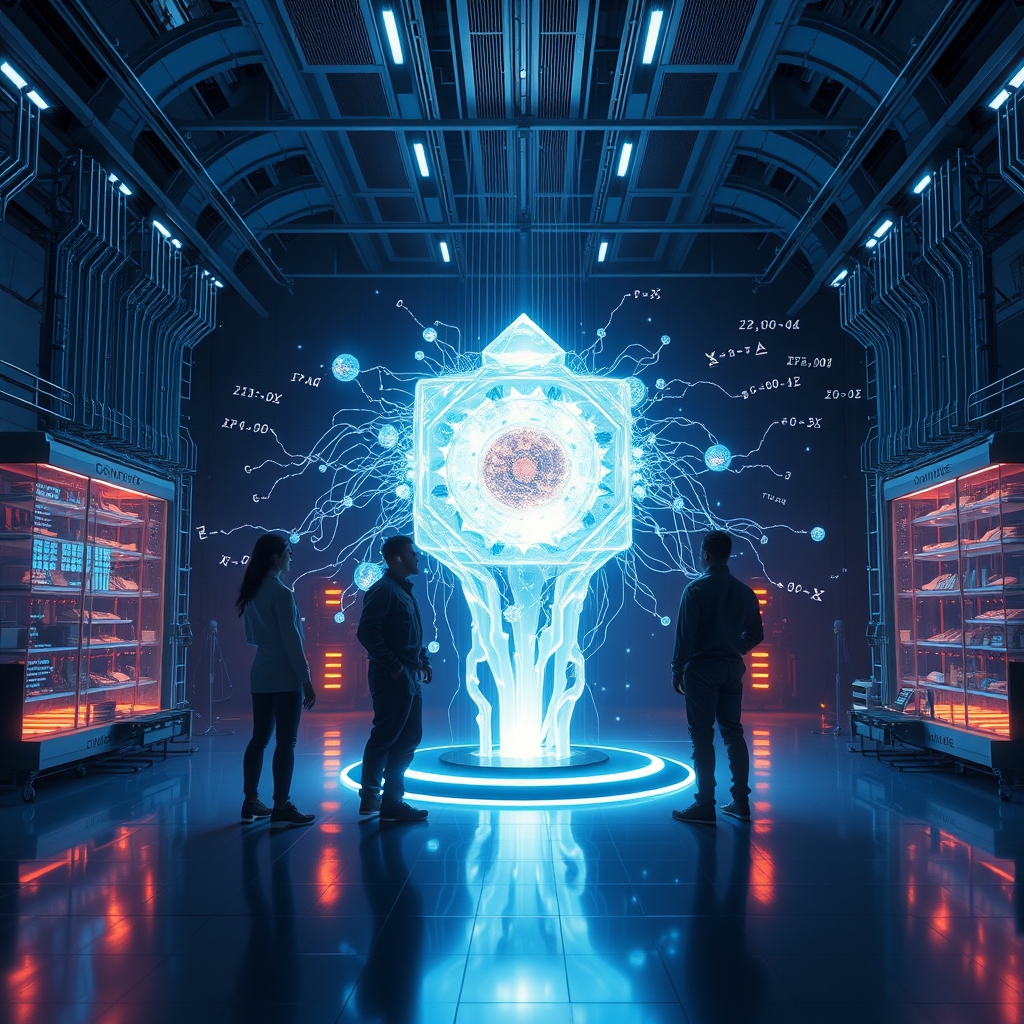
In a landmark achievement, the AI field has just witnessed a revolutionary breakthrough sending shockwaves across the globe. From Silicon Valley to Beijing, Tokyo to Berlin, the tech and industrial sectors stand astonished. This isn’t merely a technological upgrade – it represents a fundamental transformation in how humans work and live.

Artificial Intelligence, once confined to science fiction, is now integrating into our daily lives at breakneck speed. From smart homes to autonomous vehicles, AI-powered customer service to medical diagnostics, this technology is reshaping our world at an unprecedented pace. The latest breakthrough promises to propel this change to unprecedented heights.

This development poses immense challenges for numerous industries. Jobs reliant on repetitive labor and standardized processes face existential threats. From customer service representatives to accountants, translators to paralegals – countless professions face profound transformation. We’re witnessing not just technological progress, but the wholesale reinvention of traditional work structures.

—— END ——
Oh great, another highly hyped model that probably just learned to draw hands slightly better or write basic Python loops. I’ll start worrying about my livelihood when these things can actually decipher a client’s vague requirements without needing constant babysitting.
Oh boy, here we go again. Every week there’s another so-called “massive leap” that’s supposed to put us all on the streets. Wake me up when this thing can actually fix a legacy codebase without hallucinating five new bugs. Until then, I’m keeping my day job.
Another week, another “world-shattering” update that’s supposedly taking my job. Wake me up when these models can actually center a div or debug a legacy codebase without hallucinating a completely fabricated library. Until then, I’ll keep drinking my coffee.
Another week, another overhyped doompost about us all getting replaced. Call me when this thing can actually fix legacy spaghetti code without hallucinating a completely new framework. Until then, my tedious backend job is painfully secure.
We’ve been hearing this exact apocalyptic narrative every single week since GPT-3 dropped. Call me when an algorithm can actually debug a legacy codebase without hallucinating five non-existent libraries. Until then, my desk chair is perfectly safe.
read the arxiv preprint yesterday. the parameter efficiency is neat but it still hallucinates basic math. you guys love to overhype every minor update… chill, our jobs are safe for now lol
Oh look, another “landmark achievement” that will probably end up being a wrapper for something else. I’ll stick to my current tools until this proves it can handle more than simple prompts. 🙄
my boss still can’t figure out how to attach a PDF to an email, pretty sure my job is safe from this “breakthrough” for at least another decade. lol.
lol here we go again. every time i open this site there’s a new “breakthrough.” wake me up when it can handle basic math without tripping. people need to chill with the job replacement hype for five minutes.
Another “monumental” breakthrough? Wake me up when it can fix a basic bug without me babysitting it for three hours. This feels like it’s written specifically to pump VC stocks. 🙄
Not gonna lie, these “jobs are obsolete” headlines used to freak me out a few years ago, but now in 2026 it just feels like another Tuesday lol. Saw the demo for this yesterday and yeah, the new capabilities are definitely wild. It’s definitely going to shift how a lot of agencies operate this year. Still think we’re gonna need humans in the loop to fix the weird edge cases though. Good quick read anyway!
Spot on, Chris! “Just another Tuesday in 2026” is too real. 😅 The new tech is mind-blowing, but I’m with you—we’ll definitely still be playing referee for those bizarre edge cases. Glad you enjoyed the quick read!
Been tracking this since the paper dropped last night. The way it handles reasoning loops now is actually terrifying for a lot of us in backend dev. It’s not just ‘coding assistance’ anymore; it’s basically architecture on the fly. Time to seriously rethink my stack focus for the rest of the year.
Spot on, Alex! That “architecture on the fly” capability is exactly what kept me up last night too. It’s a huge shift, but pivoting toward high-level system design and AI orchestration is definitely the right play. We’re conductors now, not just coders!
Here we go again. Just when I thought my workflow was finally stabilized after the Q4 shift, this drops. The efficiency gains are insane, but yeah, the entry-level roles in my department are basically disappearing by next month. Rough times for the juniors, but I guess we adapt or get left behind.
Honestly, we all saw this trajectory coming after the Q1 releases, but seeing it actually hit the deployment stage is still a bit of a gut punch. I’ve been refactoring my team’s workflow for the last six months just to stay ahead of the curve, but if these benchmarks hold up for complex reasoning tasks, the roadmap for the rest of 2026 just got a lot more complicated. It’s no longer about “if” but how fast we can pivot our specialized roles before the next update.
Honestly, after what we saw in the Q4 updates last year, this felt inevitable, but it still hits hard seeing the benchmarks today. My team spent the whole morning sync just staring at the demo. We’ve been talking about “automation” for years, but seeing it actually handle the edge cases that used to require a senior lead… yeah, things are changing fast. Time to pivot the roadmap again.
Honestly, we all saw the trajectory late last year, but seeing the implementation speed this month is still a gut punch. I’m currently looking at our department’s Q3 roadmap and half the junior roles we were hiring for in January are already being “re-evaluated” because of this new architecture. It’s efficient, sure, but the transition is hitting way faster than the HR buffers can handle. We really are in the thick of it now.
Just read the technical specs. The way it handles long-context reasoning without the usual hallucination drift we saw last year is actually a bit unsettling. I’ve been in software for over a decade and this is the first time I’m genuinely reconsidering my specialization for the 2027 roadmap. It’s not just a “tool” anymore; it’s basically a colleague at this point. True game changer.
Marcus, that’s exactly the sentiment I’ve been hearing from devs lately. It’s wild how fast the line between “tool” and “teammate” is blurring. Stay curious—2027’s roadmap might need a few rewrites. 🚀