

Do you remember the last time you sat quietly, opened a thick book, not to prepare for an exam or to finish a short video, but simply to let a thought unfold and resonate within you? That sense of temporal depth is now being fragmented and diluted, like a sugar cube dissolving rapidly in hot water, leaving only the illusion of sweetness.
The speed at which modern information is generated has far surpassed the human brain’s capacity to digest it. According to neuroscience research, the average person is exposed to an amount of information daily that is equivalent to ten years’ worth of books in a traditional library. Frequent switching of attention leads to decreased activation frequency in the prefrontal cortex. When in this state for extended periods, the sustained focus and abstract reasoning required for deep thinking atrophy, much like a muscle that goes unused for a long time.

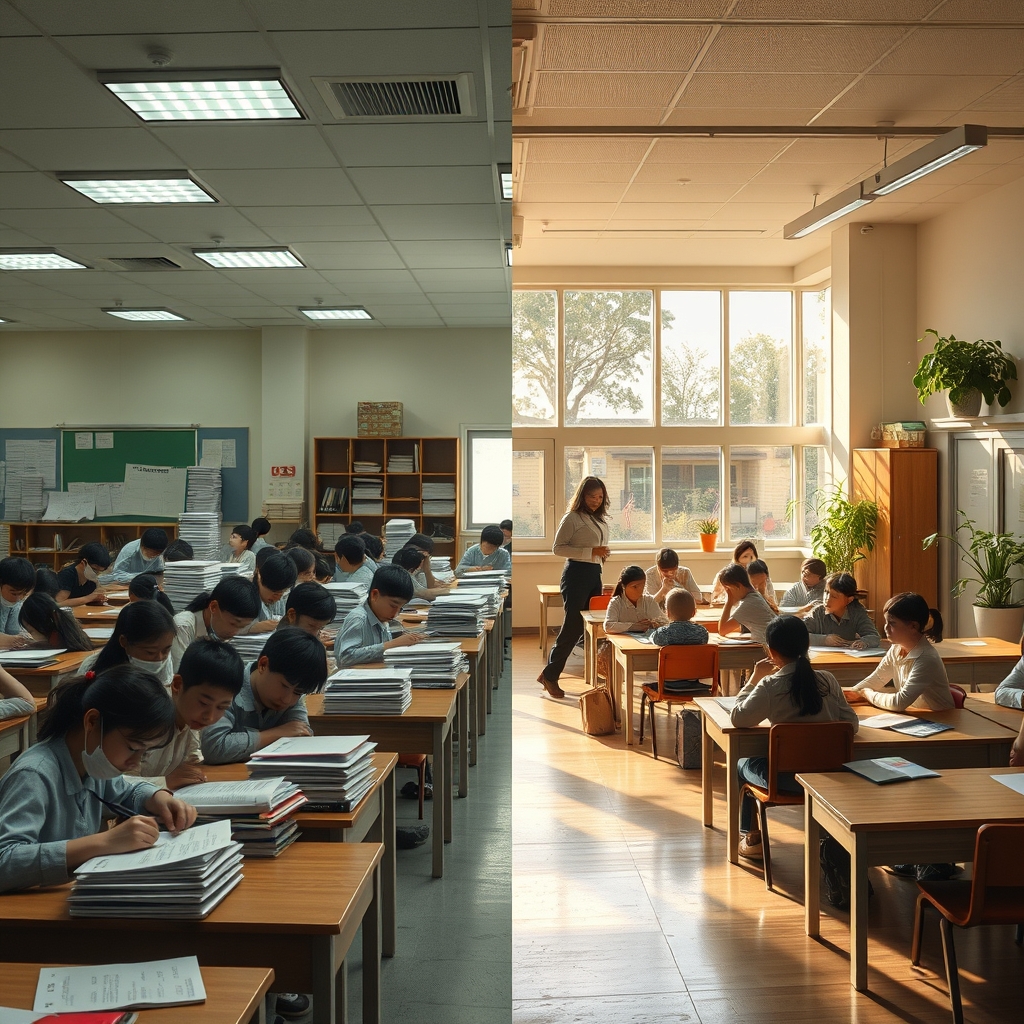
Reform slogans for the education system often adorn the walls, yet rarely impact the daily reality of the classroom. Students are trained to be answer machines, from memorizing theorems to applying templates, compressing the process of thinking into the four choices of a multiple-choice question. Teachers’ evaluation criteria are often test scores, not the depth of thought. This approach allows curiosity to quietly wither under the pressure of academic advancement.
Take Finland, for example, where primary schools have almost no standardized tests. Teachers encourage students to ask questions and conduct group investigations. In contrast, some key high schools in China implement a ‘sea-of-problems’ tactic in their senior year, having students complete hundreds of practice questions daily. Comparing the two models, Finnish students consistently score higher on creativity and problem-solving in international assessments than their Chinese peers. This is not a difference in innate talent, but a fundamental difference in how thinking is trained.
Picking up a phone to scroll through short videos has become the first and last thing many people do each day. Every refresh presents a series of carefully designed hooks—suspense, shock, beauty—that constantly trigger the brain’s dopamine circuits, trapping people in an unconscious cycle of ‘just one more.’
Long-term exposure to this high-frequency stimulation makes the brain’s reward system increasingly sensitive, while the prefrontal cortex, responsible for inhibiting impulses and performing complex reasoning, becomes dull from lack of use. Research shows that more than two hours of fragmented video viewing per day can decrease accuracy on logical reasoning tests by about 15%. This indicates that behind the sweetness of entertainment, the depth of our thinking is being quietly eroded.

Reclaiming depth doesn’t require a complete lifestyle overhaul; it starts with small, conscious rituals. Pick up a physical book, set a 30-minute timer, and resist the urge to immediately highlight or annotate—just let the thoughts settle. Pair this with a short walk in nature, allowing your mind to wander freely. Studies show this can boost creative insights by up to 40%.
When we make space for slow, deliberate thinking, we regain the ability to see patterns that algorithms cannot predict, to feel the weight of ideas before they become tweets, and to build lives that are not only efficient but also deeply meaningful. The world may be running, but the depth we cultivate within ourselves becomes a silent and unwavering compass—please let it not be silently taken from you.

— END —
I really liked the piece— it made me notice how often I reach for my phone instead of just sitting quietly with a book. The bit about deep thinking being eroded by constant distractions rang true. Good read.
Really thought‑provoking piece. I found myself putting my phone down after reading it and actually staring out the window for a few minutes. Thanks for reminding me to carve out some quiet time.
I really felt the pull of this piece. Lately I’ve noticed myself reaching for my phone the moment a thought feels even slightly uncomfortable, and it’s killing the chance to let ideas marinate. The author’s reminder to carve out even five minutes of screen‑free quiet resonates; I’ve started doing a quick “paper‑and‑pen” brain dump after lunch and it’s surprisingly refreshing. Thanks for putting this into words.
I’ve noticed the same trend in my own routine—constant notifications and quick‑scroll habits make it hard to sit down with a book or just let my mind wander. The article hits the nail on the head about how those micro‑interactions add up and chip away at our capacity for deep thought. I’ve started carving out a 20‑minute “phone‑free” block each evening, and it’s surprising how much clearer my thinking feels afterward. Thanks for putting this into words; it’s a good reminder to protect those quiet moments.
I really felt the point about how constant notifications chip away at our capacity for sustained focus. Lately I’ve been trying to leave my phone in another room during evening reading, and it’s amazing how much clearer my thoughts become after just 20 minutes of uninterrupted time. Thanks for putting this into words—it’s a reminder we all need right now.
I found the piece resonant, especially the part about how constant notifications fracture our focus. I’ve tried setting phone‑free blocks during meals and noticed I can actually follow a line of thought for longer. Still, I wonder if the issue is more about design choices than just personal habit—maybe platforms could do more to encourage deep work. Thanks for putting this into words.
Ha, yeah, the article really resonated—I’ve felt my own deep‑thinking time shrink with endless scrolling. It’s a good nudge to protect those quiet moments, even if it’s just a short break with a notebook.
Thanks, MayaK! I love the notebook idea—sometimes a quick doodle can reboot the brain better than another scroll. Keep guarding those quiet pockets; they’re gold.
Yeah, I’ve felt that too. Lately I catch myself reaching for my phone whenever I have a spare minute instead of just sitting with a book or letting my thoughts wander. It’s weird how the constant stream of short clips seems to train our brains for quick hits rather than deep focus. The article nails that shift—thanks for putting it into words.
Hey MikeT, glad it resonated! It’s wild how those bite‑size clips hijack our downtime. Try a 5‑minute phone‑free block each day—notice the shift. Thanks for sharing!
Yeah, I’ve felt that too. Lately I find myself reaching for my phone whenever I have a spare moment, and it’s hard to sit with a book or just think without the urge to check notifications. I’ve tried setting a “no‑screen” block before bed, and even a short 10‑minute pause during the day helps me feel a bit clearer. Thanks for articulating something a lot of us are experiencing but rarely talk about.
Yeah, I noticed the same thing last weekend when I tried to read a chapter without checking my phone—felt like my brain was doing push‑ups after a long nap. Good reminder to carve out some quiet time, even if it’s just ten minutes with a cup of coffee. Thanks for the post.
I really felt the article hit home. Lately I’ve noticed myself reaching for my phone whenever I have a spare minute, and it’s scary how hard it is to just sit with a book without feeling the urge to check notifications. Thanks for putting this into words.
I found the piece striking—especially the bit about how constant notifications chip away at our capacity for sustained focus. It reminded me of the mornings I try to leave my phone in another room while I read, and how even a few minutes of silence feel like a small victory. Thanks for putting this into words.
I’ve felt the same lately—trying to read a long article and finding myself reaching for my phone every few minutes. It’s scary how those micro‑interruptions add up and erode the kind of focus we used to take for granted. Thanks for putting this into words.
Yeah, I’ve felt exactly that lately — after an hour of scrolling I can’t even sit through a short article without reaching for my phone. The piece really hits the nail on the head about how our deep thinking is quietly being worn down.
Yeah, I’ve felt this too. Lately I find myself reaching for my phone every few minutes, and it’s hard to sit with a book or a thought for more than ten minutes without getting pulled away. The article hits the nail on the head about how those micro‑interactions erode our capacity for deep thinking. Still, I’ve started putting my phone on “Do Not Disturb” for short blocks and using a paper notebook for brainstorming—small steps, but they help me reclaim a bit of focus. Would love to hear what tricks others are using.
I’ve noticed the same thing—lately I catch myself reaching for my phone instead of grabbing a novel. The article’s point about how constant alerts chip away at deep focus really resonated with me. Good read.
Yeah, I’ve noticed the same thing. Whenever I try to sit down with a book or a long article, my phone buzzes every few minutes and I end up skimming instead of really absorbing. It’s frustrating because I miss those moments when ideas actually click. I’ve started turning off notifications for an hour each night, and it helps a bit, but the habit is hard to break. Thanks for putting this into words.
I’ve felt this too lately—trying to read a chapter without checking my phone feels almost impossible. The constant stream of notifications really chips away at those deep‑thinking moments. It’s good to see the issue laid out so clearly; thanks for putting it into words.
Really hit home—I caught myself scrolling instead of reading a book last night. Felt that tug of distraction. Thanks for putting it into words.
Read this on July 7, 2026 while waiting for my coffee. The part about notification overload really hit home—I’ve noticed my own focus drifting after just a few minutes of scrolling. Thanks for putting it into words.
I’ve noticed myself reaching for my phone whenever I try to read a long article, and it’s frustrating. The piece hit home—thanks for putting it into words.
The article hit home—I’ve felt my focus slipping with endless scrolling. Putting my phone on do-not-disturb during work blocks has already helped me dive deeper into projects.
I felt exactly the same after trying to read a book on the subway—constant notifications pulled me out of every paragraph. It’s scary how easily our focus gets fragmented these days.
I really felt that after scrolling through endless feeds, I struggle to sit with a book for more than ten minutes. The article nails that quiet dread. Thanks for putting it into words.
I felt a pang of recognition when the piece talked about losing those quiet moments with a book. Lately I’ve been trying to leave my phone in another room for at least 20 minutes each evening, and it actually helps me focus better. Thanks for putting this into words.
I really felt that point about constant notifications chopping our focus. I’ve noticed myself reaching for my phone even when I’m trying to read a book. It’s scary how subtle it is.
The article hit home—especially the bit about how endless scrolling erodes our capacity for deep focus. I’ve caught myself checking my phone mid-conversation more often lately, and it’s a wake‑up call to set clearer boundaries with my devices.
I felt this hit home when I tried to read a novel during my lunch break—constant pings from my phone kept pulling me out of the story. It’s reassuring to see someone articulate the quiet erosion of deep focus we all experience.