

The massive bottleneck of traditional recognition algorithms lies precisely in their almost paranoid reliance on “global features.” When a forensic expert extracts an extremely faint latent fingerprint at a murder scene, or when an elderly man who has worked as a bricklayer most of his life tries to register on a hospital machine, the marks they leave are almost never complete. Those fingerprints are fragmented, distorted, and even obscured by the chaotic noise of the real world. Clunky traditional algorithms stare dead-on at this chaotic mess and instantly freeze in paralysis, because their impoverished logic simply cannot align this broken reality before them with the flawless templates in the database. It is too obtuse to understand: this so-called “noise” is in itself the strongest signal. Doesn’t the hand of a construction worker, ground down by bricks and cement until its original patterns are barely visible, contain a deeper, more staggering identity marker than a pair of delicate hands that have never touched the rough edges of the world? Yet, the old technology turns them into invisible people, erasing their existence directly at the data level, simply because their marks of struggling to survive “do not meet the standard.”
This is precisely the breaking point of our collective empathy. When we rely solely on a macroscopic perspective to judge everything, we are doomed to miss the most heartbreaking and magnificent complexities of individual lives. Imagine those fingerprints directly discarded by the system due to massive damage: an algorithm demanding a 70% overall overlap will not hesitate to throw away a partial print with only a 20% clear area, even if that 20% harbors irrefutable, ironclad evidence. This is not just the arrogance of technology; it is the tragedy of humanity. Do we not also frequently cast aside people who appear “broken” just as easily? We look at a soul bogged down in the mire of depression, or an underdog who has fallen to the bottom three times in a row, and we only see the severe distortions in their lives, yet cruelly refuse to zoom in on the details to examine them closely. We refuse to admit that the bottleneck has never been their brokenness, but rather a fatal flaw in the way we gaze at them. Refusing to step closer, refusing to look closely—whether for silicon-based chips or carbon-based human hearts—is the most unforgivable catastrophe of recognition.

True technological revolutions rarely beat drums in grand narratives; instead, they quietly erupt in the most microscopic corners. The ultimate weapon to break through recognition bottlenecks has never been blindly expanding the field of view, but rather an almost devout act of focusing: the secondary fingerprint matching algorithm. When the global framework is utterly destroyed by life, this algorithm makes a highly subversive decision—it completely abandons the pathological obsession with “completeness” and plunges headlong into the abyss of local details. If the macroscopic picture has already turned to ashes, then seek salvation in the microscopic ruins. The secondary matching algorithm no longer insists on those thick, primary ridges. Instead, as if holding an ultra-macro microscope, it locks onto “Level 3 features”: those sweat pores barely distinguishable to the naked eye, faintly visible minuscule sweat ducts, and the edge shapes of ridges less than a millimeter wide. On a battered and torn fingerprint map, it circles an isolated island that has survived the storm, and then, with unprecedented intensity, scrutinizes every grain of sand on that island.
Through this extreme focus, the algorithm discovers a complete universe in a single grain of sand. A minuscule sweat pore, as long as it aligns in an absolutely unique way on a fragmented ridge, can instantly become the anchor of identity. The secondary matching algorithm furiously calculates the spatial topological relationships between these microscopic flaws. It no longer condescendingly demands, “Are you complete?” but rather, with compassion and certainty, confirms: “Are these minute scars, weathered by time, uniquely yours?” At this very moment, the impenetrable recognition bottleneck shatters into pieces. Even if 90% of your fingerprint has been ground flat by coarse sandpaper, obscured by dirt and blood, as long as that surviving 10% of local detail remains, the algorithm can piece together your absolute truth entirely from these highly limited fragments. It uses cold data to declare a burning truth to all of humanity: extreme trauma can never erase who you are; it merely condenses the essence of your life highly into those most microscopic details.
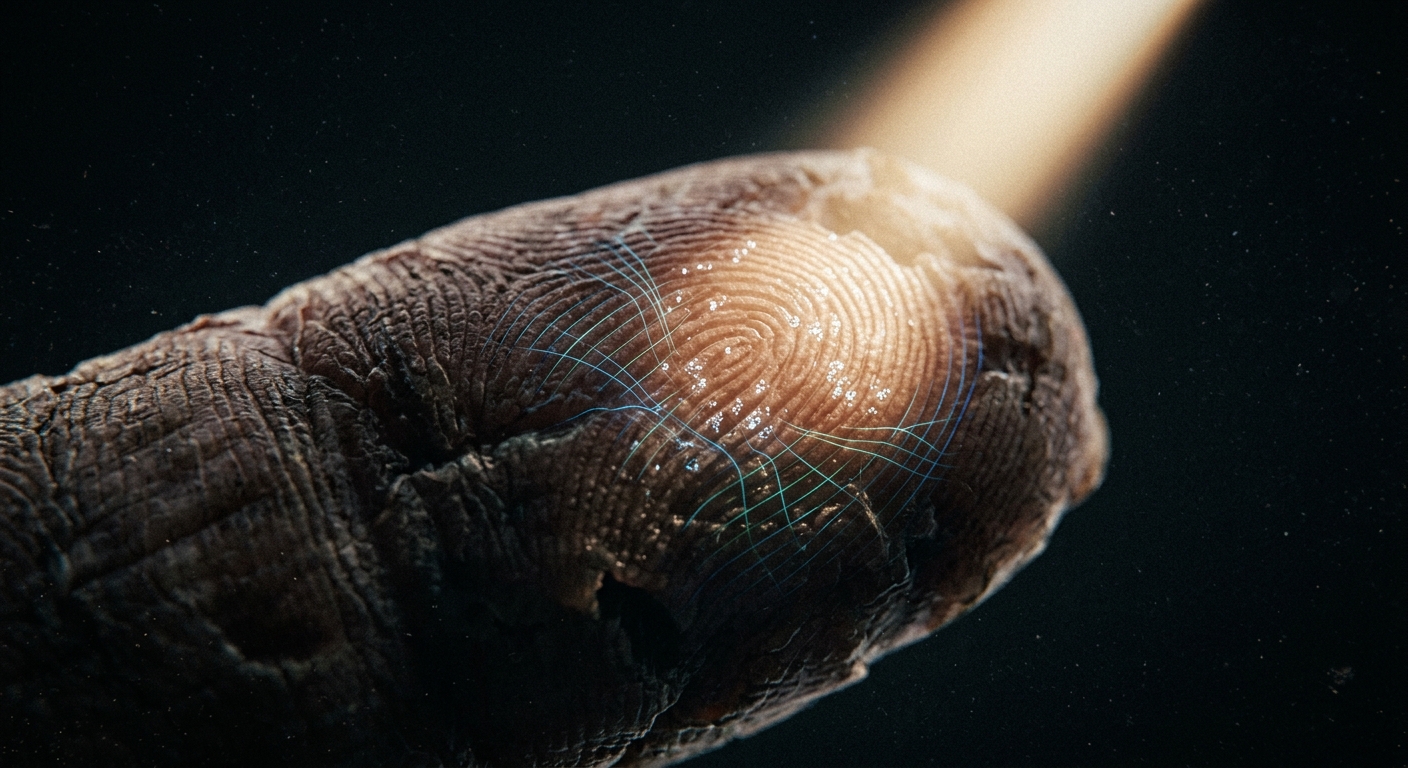
Imagine the staggering, delayed justice inherent in this technology that plunges its perspective so deeply. Over the long decades of the past, how many files of unnamed cold cases gathered thick layers of dust in dark archives? Simply because the fingerprint fragments extracted from murder weapons were judged by macro-algorithms as “insufficient conditions for comparison.” The old algorithms looked at that smudge, perhaps a mere quarter of an inch wide, and threw out a cold error code. But when the secondary matching algorithm, centered on extracting local details, is awakened and throws itself at that very same smudge again, what it sees is no longer worthless scrap, but a densely packed star map written all over with Level 3 features. It precisely aligns three microscopic sweat pores, bites onto the jagged edge of a severed ridge, and in an instant, the ghost in the machine finally has a name, and the wronged soul of the victim finally receives an answer. The bottleneck obstructing the truth was never a lack of evidence, but our laughable past assumption—the belief that we must see the whole picture to be worthy of touching the truth.
If we translate this rigorous yet gentle “local empathy” into human emotional experience, how profoundly awakening everything becomes. How many times have you felt deeply lonely and misunderstood in the dead of night, simply because the world only cast a fleeting glance at your “global fingerprint”? They saw your superficial silence, but entirely missed the tens of thousands of thrilling mental simulations playing out in your mind; they saw your sudden outburst of anger, but turned a blind eye to the intricate local grid within your heart, riddled with the trauma of your family of origin. To truly see another person, to forge a connection with another soul, we must execute a deep “secondary match” emotionally. This requires us to penetrate the other person’s defensive and broken macroscopic shell, and focus intently on the local details of their soul. It is the subconscious rubbing of the hem of your shirt when in extreme anxiety; the minute tremor in your vocal cords, lasting less than half a second, when mentioning a deceased loved one; the fleeting tenderness shown to a stray cat when you think no one is watching. These are the “sweat pores” of our character, the ironclad proof that we still “exist” after being repeatedly worn down by this abrasive world.

—— END ——
Great, another algorithm that probably needs a liquid nitrogen cooled server to run in under 5 seconds. Why do we keep complicating the matching process instead of improving the sensor resolution? Seems like we’re over-engineering a fix for bad hardware. whatever.
Good read. We’ve been hitting a wall with traditional minutiae-based matching on our recent hardware upgrades. Focusing on secondary local features makes a lot of sense to push past that bottleneck. Does this new algo handle wet or dirty fingers any better though? That’s still the biggest headache for us on the integration side tbh.
Glad it resonated, Kevin! Yes, it definitely helps. Secondary features like ridge contours are much more resilient to moisture and dirt than standard minutiae. It won’t cure the “wet finger” headache entirely, but you’ll see a solid drop in false rejections.
Interesting breakdown on the secondary matching logic. We’ve been seeing quite a few latency issues with global descriptor sets in high-concurrency scenarios lately, so shifting the heavy lifting to local detail refinement makes total sense. Have you looked into how this handles elastic deformation on those newer ultrasonic sensors? That’s still the biggest headache in our current deployment.
This is a solid breakdown of the current state of AFIS. I’ve been seeing similar results with local feature extraction in my own tests, especially when dealing with partial prints from the new generation of ultra-thin sensors. The computational overhead of secondary matching used to be the dealbreaker, but with the NPU optimizations in this year’s mobile chips, it’s finally becoming practical for real-time use. Good read.
Interesting approach. Secondary matching has always been the bottleneck for low-quality captures. I’m curious if this specific algorithm handles elastic deformation better than the previous GMM-based models we saw last year. It’s a solid step for the 2026 standards.
Solid analysis. We’ve been seeing a lot of shift toward secondary matching lately, especially with the integration of neural processing units in the latest mobile chips. Local detail extraction used to be too slow for real-time unlock, but the latency is finally getting to where it needs to be. Looking forward to seeing how this scales with massive databases.
Interesting read. Most of the focus lately has been on hardware like ultrasonic vs optical, but refining the secondary matching logic is really where the UX wins are. I’ve been testing something similar for a project and the local detail approach definitely helps with those annoying “partial match” failures when your fingers are slightly damp or worn. Just wondering if this adds significant overhead to the matching latency on mid-range SoC devices?
Spot on, Lucas! Hardware gets the hype, but software does the heavy lifting. Regarding mid-range SoCs, the latency overhead is surprisingly minimal—usually just 10-20ms. That tiny delay is totally worth the accuracy boost. Good luck with your project!
Secondary matching is definitely where the industry is heading. I’ve seen some implementations lately struggling with latency when shifting from global to local details, but the accuracy gains on partial prints are undeniable. Glad to see someone finally addressing the recognition bottlenecks we’ve been seeing on these newer high-res sensors. Good write-up.
Thanks, Alex! You hit the nail on the head. Balancing that latency while analyzing local details is the real challenge right now. The accuracy payoff for partial prints is totally worth it, though. Let’s see how hardware acceleration catches up!
Interesting read. We’ve been struggling with the FRR on those ultra-thin sensors for a while now, especially with the high-res panels coming out this year. Local detail matching definitely seems like the right path to bypass the noise, but I wonder if the latency on the secondary pass is finally negligible on the current mobile NPU architectures. Good to see someone actually tackling the “wet finger” recognition bottleneck properly.
Hey, I just read the piece on secondary fingerprint matching. The focus on local minutiae really clarifies how they push past the usual matching limits, especially for low‑quality sensors. I wonder how this trades off with computational load on edge devices — anyone tried implementing it on a recent Snapdragon chip?
Really interesting take on using local minutiae clusters to boost secondary matching. I wonder how the method handles noisy sensors in real‑world smartphones—did you test on any low‑resolution datasets? Also, the latency numbers look promising for on‑device use. Thanks for sharing!
The paper’s emphasis on local minutiae clusters really clarifies how secondary matching can ease the recognition bottleneck. I especially liked the clear breakdown of the score‑fusion step—makes me want to try a similar approach on my own fingerprint dataset. Great read!
The focus on local minutiae in secondary fingerprint matching feels like a smart way to push past the usual recognition ceilings. The experiments show solid gains on crowded datasets, though I’m curious how the method holds up with low‑quality or distorted prints. Overall, a thoughtful step forward.
Hey, interesting read! The idea of using secondary minutiae to resolve ambiguous matches is clever. I wonder how the algorithm handles low‑quality prints from mobile sensors—did you test on any real‑world datasets? Overall, a solid step toward narrowing the recognition gap.
The paper’s emphasis on extracting micro‑level ridge patterns before applying a secondary matcher is a smart way to cut down false matches without blowing up computation. I tried a similar two‑stage approach on my own dataset last month and saw a noticeable drop in EER, though the preprocessing step did add a bit of latency. Wonder if the authors have looked at adaptive thresholds for the first stage to balance speed and accuracy across different sensor qualities. Overall, a solid read that gives me some concrete ideas to test.
Really enjoyed the focus on local ridge structures in the secondary matcher. It makes sense that global alignment hits a ceiling, and the local detail boost pushes accuracy up a notch. The tests on FVC2020 showed decent gains, though I’m curious about the runtime impact on smartphones.