
Imagine you spend years honing a brushstroke, only to wake up one morning and see your signature style splashed across a viral poster, the creator listed not as you but as an algorithm that never held a pencil. The sensation is less surprise than a quiet grief, as if a part of your voice has been rented out without consent.
Across the street, a software engineer feeds terabytes of novels, poems, and paintings into a black‑box model, then watches the machine spit out a fresh short story that reads eerily like your favorite author. Who gets to claim that story as theirs? The coder who wrote the code, the corporation that owns the servers, or the countless unseen authors whose words trained the network?
Copyright law was built on a simple idea: the author is the human who translates an idea into a fixed, original expression. From the Statute of Anne to the Berne Convention, the law has always required a human mind behind the work, because only a person can possess the intent and personality that the statute protects.
Yet the Copyright Office has repeatedly refused registration for works generated solely by AI, citing the lack of a human author. The “Monkey Selfie” case showed that even non‑human creators cannot hold rights, and the recent denial of registration to the AI‑generated comic “Zarya of the Dawn” reinforced that stance, leaving a legal vacuum where machine‑made art drifts without an owner.
For illustrators and musicians, the rise of AI feels like a betrayal. They watch their portfolios scraped, their styles distilled into prompts, and then see cheap, AI‑generated imitations flood marketplaces, undercutting the prices they once commanded. The emotional toll is not just financial; it is the erosion of identity, as if the very signature that once said “I made this” is being erased.
Tech firms counter that their models are merely tools, akin to a camera or a synthesizer, and that the data they ingest is publicly available or licensed. They argue that restricting AI would choke innovation, depriving society of new forms of expression that could democratize creativity for those who lack traditional training or resources.
Imagine a future where every novel, every melody, every visual piece is first drafted by an algorithm, and the human creator is reduced to a mere button‑presser. If we allow the law to remain silent, we risk a cultural landscape where originality is measured not by the spark of human imagination but by the size of the training corpus.
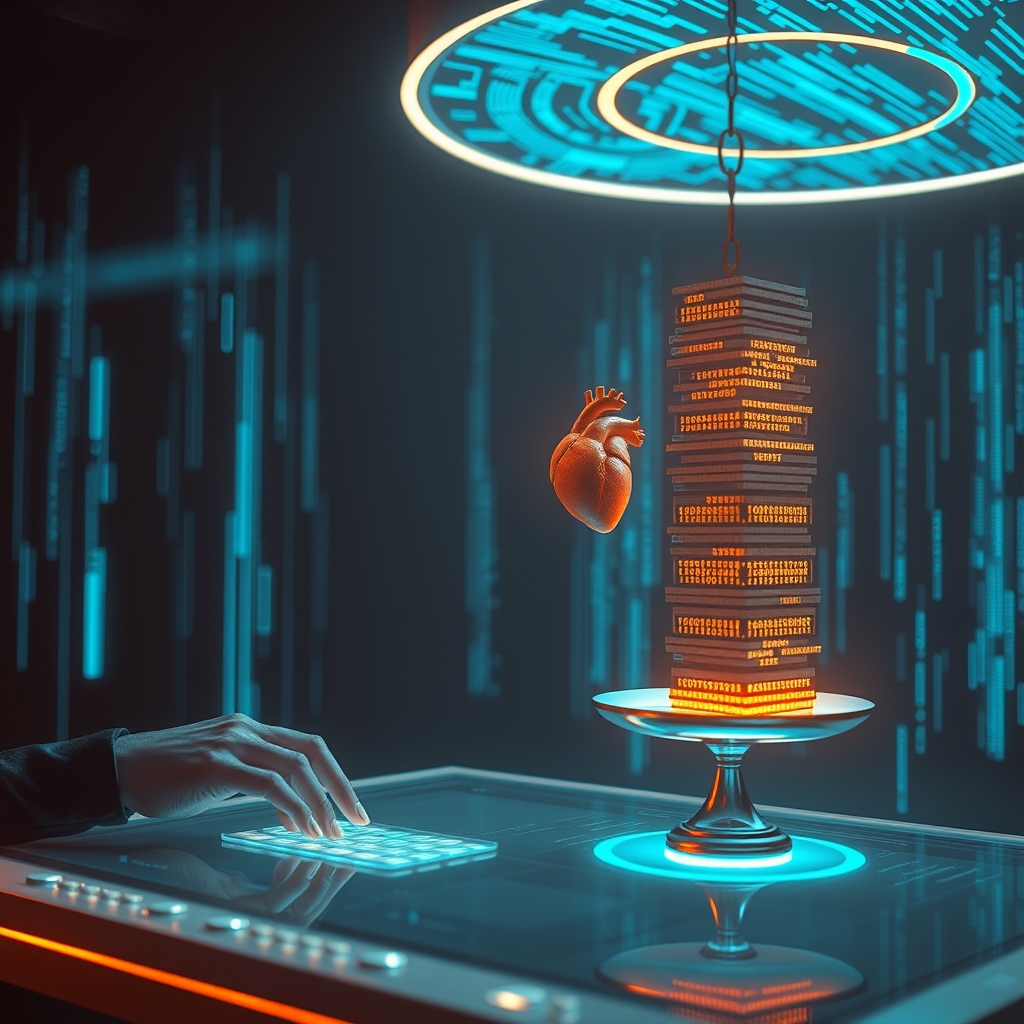
The choice is ours: will we forge a framework that honors both the ingenuity of the machine and the irreplaceable role of the human heart, or will we let the scales tip toward convenience at the cost of soul? The answer will shape not only who owns a file, but who gets to tell the story of what it means to create.
—— END ——
Hey, really enjoyed the piece. It made me think about how much the prompt itself shapes the output—if I spend time tweaking the wording, choosing styles, and iterating, that feels like a creative contribution worthy of some rights. At the same time, the model’s training data is a huge part of the equation. Maybe a hybrid approach, where the user gets a share for their creative input and the platform/model gets a baseline for the underlying tech, could work. Good read—thanks for sparking the discussion!
I read the piece and found the discussion on authorship quite timely. While the AI itself can’t hold rights, the line between the tool’s output and the user’s creative input feels blurrier each day. I think a shared‑ownership model—recognizing both the programmer’s contribution and the prompter’s direction—might be a pragmatic way forward, at least until legislation catches up. Worth watching how courts handle the next wave of cases.
Hey, I found the piece on AI‑generated copyright really timely. It’s clear that many platforms already treat the prompter as the rights holder, but the legal gray zone still causes headaches for creators and companies alike. A pragmatic approach—viewing the AI as a tool and giving the user a limited license while keeping the model’s output in the public domain—could balance innovation with fairness, much like how we handle photographs taken with a camera. Would be great to see more concrete rulings emerge this year.
Thanks, LinaWang! I agree—treating AI as a tool and granting users a limited license while keeping outputs public‑domain could strike that balance. Hope courts clarify soon.
Read the piece this morning while having coffee. The author raises a good point about the tension between treating AI as a mere tool versus recognizing the creative input of the human prompter. In 2026, we’ve seen a few court rulings in the EU and US that lean toward assigning copyright to the person who exercised substantial creative control, but the line is still blurry. I wonder if a hybrid model—shared rights or a compulsory license—might work better for collaborative AI art. Would love to hear others’ thoughts, especially from those who’ve actually tried selling AI‑generated designs.
Really enjoyed the piece—it laid out the tension between creator intent and AI training data clearly. I think we need a nuanced approach that recognizes both the human curation involved in prompting and the model’s learned patterns, rather than assigning ownership to just one side. Looking forward to seeing how courts and policymakers tackle this in the coming months.
I found the piece really thought‑provoking, especially the way it ties current case law to the practical dilemmas creators face when using AI tools. It’s clear that the “author” concept needs updating, but any solution will have to balance incentivizing human creativity with not stifling innovation. Would love to see follow‑up examples of how jurisdictions are actually handling these disputes in 2026.
Interesting read. The point about human artists feeling sidelined by AI-made works resonates, but I think the law will likely treat the AI as a tool, so the person who prompts or curates gets the credit. Still, we need clearer rules for training data. Thanks for the piece.
Hey, interesting read. I’ve been wrestling with this myself—when I use Midjourney for concept art, I always wonder who really holds the rights. The article makes a solid point about the user’s creative prompts being a key factor, but I also think we can’t ignore the model’s training data. Would love to see how courts handle this as cases arise.
Really enjoyed the breakdown of the legal gray areas. It’s clear that the current laws weren’t built for AI creations, and we need a practical framework soon—maybe something like a shared rights model between the user, the tool developer, and the data providers. Thanks for sparking the conversation!
Really enjoyed the breakdown of the legal gray areas around AI art. The point about training data vs. output really clicked for me. Thanks for the clear examples!
Glad the training vs output point helped!
Great article. It’s fascinating to see the debate over who owns AI‑generated art. I’m curious how courts are handling similar cases right now.
The article hits a sore point for many creators. It’s tricky to decide who owns the output when the model is trained on countless works. I think we need clearer laws that consider both the user’s prompt and the training data, otherwise we’ll keep seeing these disputes.
Really interesting read. As someone who dabbles in both photography and AI art, I’ve been wrestling with the same question: who gets credit when the model spits out something that looks like my style? The piece does a good job laying out the current legal gray areas without getting too academic. Thanks for sharing.
Interesting read. I wonder how courts will handle the derivative works issue when the training data includes copyrighted material. Anyone seen recent cases?
The article does a good job highlighting the tension between user prompts and model output. It made me think about how current lawsuits are already testing these boundaries.
I found the article’s comparison between AI‑generated art and early photography debates spot on. The way the author ties recent copyright cases to the issue of training data makes the argument feel grounded, not speculative.
Really enjoyed the breakdown of the current legal gray zones—especially the point about how training data licenses complicate ownership. It made me think about my own experiments with generative art and how I usually just add a CC‑BY note until clearer rules emerge.
Really enjoyed the breakdown of the copyright issue—makes me think about how I use AI art for my hobby projects. Would love to see more case studies on how courts are handling this.
Really enjoyed the piece. The analogy to a brushstroke hits home—makes you think about where the line is drawn between tool and creator. Hope we see more concrete guidelines emerging.
Really enjoyed the piece—makes me think about how current copyright law struggles to keep up with the speed of AI tools. The examples about training data vs. output were spot on. Thanks for the clear breakdown.
Interesting read. I wonder how courts will treat the training data aspect. Also, the point about human prompting being minimal resonates with my own experiments. Thanks for sharing.
Really enjoyed the piece—it nailed the tension between prompt engineering and traditional authorship. As someone who dabbles in both digital art and occasional freelance writing, I find the idea of treating the AI as a tool rather than a creator more convincing, but I wonder how courts will handle cases where the user’s input is minimal. Curious to see if any jurisdictions start drafting specific statutes soon.
Really enjoyed the piece— as someone who dabbles in AI art for side projects, it’s clarifying to see how the courts are starting to treat the output as work‑for‑hire versus user‑owned. It makes me double‑check the terms of service before I upload anything to a marketplace.
Interesting read. The line between user prompting and model training data makes ownership murky. I wonder if courts will lean toward treating the AI as a tool, leaving rights to the human who supplied the creative direction.
Nice point, Alex! If AI’s a tool, prompter owns rights.
I found the piece really helpful in clarifying the current legal gray zone—especially the part about how training data influences ownership. As someone who tinkers with generative tools for hobby projects, I wonder how courts will treat prompts vs. model weights. Thanks for the nuanced take.
Really enjoyed the article. It highlights how messy things get when AI outputs resemble human artwork. As someone who dabbles in digital painting, I feel the attribution problem is real and think clearer rules are needed.