

When you wake up in the morning, habitually grab a coffee, sit in front of your dual monitors, and prepare to open your IDE to start the day, a deafening death knell is already echoing in the skies above Silicon Valley. This isn’t the wild raving of some startup, but a genuine industry earthquake: the Big Three tech giants have simultaneously hit the “stop” button on manual coding in their internal development workflows. Microsoft’s Copilot has deeply taken over core business repositories, Google’s internal large AI models are rewriting decade-old legacy systems, and Amazon’s engineers are being asked to transition from “code writers” to “AI code reviewers.” The era where humans built digital empires by banging out tens of thousands of lines of code on a keyboard is collapsing at a terrifying speed.
Do you really think this is just an ordinary tool upgrade? Do you think it will be as uneventful as upgrading from Notepad to an advanced editor, or switching from SVN to Git? Stop numbing your nerves with such feeble self-consolation. The collective abandonment of manual coding by these giants means the fundamental rules of the game have been completely torn to shreds. The endlessly blinking cursor on your screen, once the wellspring of your proud creativity, has now become a ticking countdown. Those complex business logics you once pulled all-nighters to get running, those low-level architectural refactors you thought were sheer brilliance—today’s AI agents can finish them in under three minutes, complete with perfect unit tests and exhaustive documentation. This technological storm has absolutely no intention of giving you a moment to catch your breath.
We are witnessing an exceptionally brutal workplace purge. The most terrifying part is that the blade is already at our necks, yet many are still debating what the blade is made of. You might think you’re irreplaceable, but capital calculates its margins sharper than anyone. When a tireless AI system—one that doesn’t need social security, and won’t suffer an emotional breakdown over changing requirements—can output high-quality code at ten times the speed of a human, those highly paid “senior engineers” whose only skill is writing CRUD applications become nothing more than bloated toxic assets in the eyes of the CFO.

For a long time, the programmer community has been wrapped in a massive illusion of being “tech elites.” We’ve grown accustomed to seeing ourselves as the creators of the digital age, believing that mastering arcane programming languages and complex algorithms guarantees a permanent ticket to the middle class. We’ve argued until we’re red in the face on forums over which is the best programming language in the world, and felt an overwhelming sense of superiority in code reviews over a naming convention or the application of a design pattern. But take an honest look at your daily work: strip away the fancy architectural jargon, and how much of the code you type every day actually possesses irreplaceable creativity? How much of it is merely the manual labor of shuttling data from the database to the frontend?
The truth is often bloody: the vast majority of programmers are not architects, but veritable “textile workers” and “bricklayers” of the digital age. Day in and day out, we patch bugs in massive business systems and drain our youth in endless API integrations. We used to laugh at the first generation of AI for only writing broken boilerplate code, convinced it could never grasp complex business logic. But today, when you see fully autonomous AI software engineers like Devin independently reading API docs, troubleshooting environment errors, and even deploying products entirely on their own, what is left of your pitiful technical arrogance?
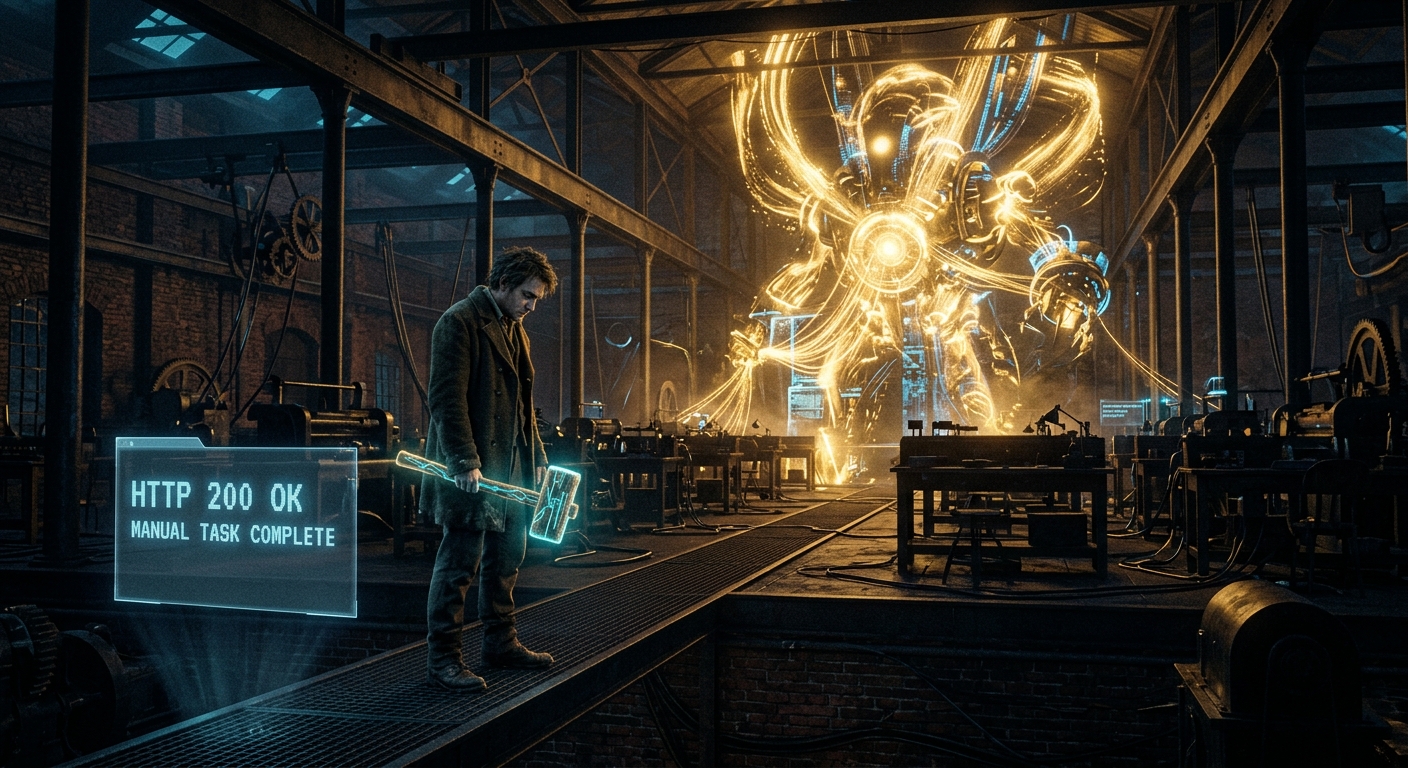
The pivot of the tech giants shows they have seen right through this cold truth. They don’t need tens of thousands of “typists” who merely translate requirement documents into code; they need thinkers who can directly turn commercial intent into products. When the barrier of manual coding is completely leveled by AI, the syntax memory, debugging experience, and even shortcut fluency you once took pride in instantly become worthless. It’s like proudly flexing your muscles swinging a sledgehammer in front of an Industrial Revolution steam engine. When the times abandon you, they won’t even say sorry; they’ll just leave behind a cold HTTP 200 OK status code.
Now, turn your gaze to the already blood-soaked job market. Don’t simply attribute the wave of layoffs at major tech companies to a cyclical macroeconomic winter—that is merely a fig leaf used by capital to mask the mutation of the underlying logic. What is truly despair-inducing is the structural evaporation of demand. The door for junior engineers is being slammed firmly shut. In the past, companies were willing to hire inexperienced interns, feed them with projects, and wait for them to grow into the backbone of the team. But now, why spend money training a rookie who might jump ship at any moment, instead of directly using a large AI model that possesses the capabilities of a senior engineer and can be cloned infinitely?
That once-crystal-clear career ladder—grinding algorithm questions, joining Big Tech, securing stock options, and buying a house to climb the social ladder—has now been brutally severed. In daily stand-up meetings, you can literally smell the anxiety permeating the air. Many have begun instinctively resisting AI, trying to write certain core code as obscurely as possible, attempting to deeply tie the business logic to their own brains, thinking this will secure their livelihoods. But this laughable resistance is like holding up an umbrella to try and stop a tsunami.
You must understand that when a tech giant announces over half of the code in its products is AI-generated, it means 50% of the execution has been entirely taken over by machines. Next, that ratio will be 80%, or even 99%. The living space left for traditional programmers is collapsing at a visible rate. If, in the face of such a cliff-edge freefall, you are still fantasizing about coasting by on your mastery of some outdated framework, you are destined to become the first batch of casualties in this massive digital meat grinder.

—— END ——
It’s been a crazy transition. Just finished a major project yesterday and realized I haven’t manually written a unit test in over six months. The Big Three jumping ship just confirms what we’re all seeing on the ground. It’s definitely a “specialize or die” era now. Definitely feels weird not touching the boilerplate anymore.
It’s wild how fast this happened. I remember back in ’23 we were still arguing if Copilot was “cheating,” and now if you try to type out a full function manually, the IDE basically asks if you’re feeling okay. The transition for the Big Three makes total sense—maintaining human-written syntax at that scale is just a massive technical debt now. It’s all about system architecture and high-level logic flow these days. Just glad I stopped obsessing over semicolons when I did.
Just saw this on my feed. It’s wild how fast “manual coding” became a hobbyist term. I spent most of today just auditing the AI’s logic flow for a new deployment. The “big three” moving away from manual input completely is just the final nail in the coffin for the old way of working. It’s faster, sure, but the debugging sessions are getting way more abstract.
Honestly, looking back at 2024, I can’t believe how much time we wasted manually typing out logic. Now it’s all about high-level system design and security reviews. If you’re still trying to “write” code line-by-line today, you’re basically acting like a digital stonemason in the era of pre-fab skyscrapers. The shift is real, and if you haven’t mastered prompt-based orchestration by now, you’re already behind.
“Digital stonemason” is a brilliant analogy, Mark! I couldn’t agree more. We’ve evolved from syntax typists to true system architects. Prompt orchestration isn’t just a trendy skill anymore; it’s the new baseline for survival. Keep building those skyscrapers!
Man, reading this while my agent is literally refactoring a legacy module in the background. It’s wild how fast the “manual” era died. My junior just started last month and honestly, I don’t think he’s ever seen a blank IDE screen. We’re basically high-level architects now, just guiding the logic. Kind of miss the “flow state” of typing out every line, but I definitely don’t miss debugging syntax for three hours. This transition was inevitable.
Alex_K_Dev, sounds like you’re living the future right now—refactoring in the background while reading about the shift. That’s some next-level workflow. The “flow state” nostalgia hits hard, but I’d trade a few hours of syntax debugging for sanity any day. Here’s to guiding the logic and letting AI handle the grind!
It’s wild how fast the industry flipped. I spent all of last week just auditing logic flows generated by our internal engine instead of writing a single line of boilerplate. Seeing the Big Three officially call it quits on manual coding feels like the final nail for the “junior dev” era. It’s efficient, yeah, but definitely a different kind of mental burnout than we had back in ’24. Progress, I guess.
The article raises a valid point about AI handling more routine coding tasks, but I’ve seen that even with tools like Copilot, senior engineers still spend a lot of time on design, debugging, and stakeholder communication. It’s less about abandoning manual coding and more about shifting where human effort adds the most value. Worth watching how teams adapt their workflows over the next year.
Yeah, definitely an eye‑opening article. I’ve been relying on AI assistants for routine scaffolding for a while now, and they cut down the grunt work a lot. Still, when it comes to system design or tracking down subtle bugs, I’m back to writing code manually. The idea that the Big Three have completely abandoned manual coding feels more like a shift toward AI‑augmented workflows than a total replacement. Would be curious to see any hard data on the proportion of AI‑generated LOC versus hand‑written code in their repos. Thanks for sparking the conversation—our team Slack lit up after I shared this.
Yeah, pretty neat—just read the piece about the big three tech giants ditching manual coding. It’s striking how fast generative AI is slipping into dev workflows, moving from simple autocomplete to actually drafting whole modules. Curious if anyone’s already measuring tangible productivity gains in their sprints, or if we’re mostly riding the hype wave for now.
Just finished my morning coffee and read this piece. It’s striking how quickly AI‑assisted tools have moved from novelty to everyday workflow in many shops. While the idea of completely abandoning manual coding feels a bit extreme today, the article does highlight a real shift—developers are spending more time on architecture, prompt engineering, and reviewing AI output than on writing boilerplate. Curious to see how education and hiring practices adapt over the next year or two. — Alex
Hey, just read the piece. As of May 5, 2026, I see AI tools handling a lot of boilerplate, but we still need engineers for architecture and edge cases. The shift is real, but calling manual coding completely abandoned feels premature. Curious how others are adapting in their teams.
The article raises a good point about AI reshaping coding habits, but from what I’ve seen on the ground, big tech still leans on human engineers for system design, code review, and handling edge cases. AI assistants speed up boilerplate and testing, yet they haven’t eliminated the need for strong programming fundamentals. It’d be interesting to hear how different teams are integrating these tools into their daily pipelines.
Just finished my morning coffee and came across this piece. I’ve been using AI‑assisted coding tools for a while now, and they definitely cut down on repetitive boilerplate. Still, designing solid architectures, catching subtle bugs, and making product‑focused decisions still feel very human. It’ll be interesting to see how companies balance upskilling with these new workflows.
Hey, I’ve been using GitHub Copilot and similar tools for a few months now, and they definitely speed up boilerplate work, but the core design and debugging still need human judgment. It’s interesting to see how the workflow is shifting rather than disappearing entirely. Thanks for the article—it gave me a good snapshot of where we’re at right now.
Yeah, I saw this piece this morning while waiting for my bus. It’s interesting how quickly AI tools are moving from assistive to taking over whole workflows, but I wonder how much of this is hype vs real adoption in everyday dev teams. Still, it’s a good reminder to keep learning the fundamentals even as the tools change.
Ha, yeah, feels good to see the shift, but I wonder how much of it is hype vs real productivity gains. In my squad we’ve cut boilerplate time with AI, yet the tricky architecture calls still need a human touch. Curious to hear what others are seeing on the ground.